
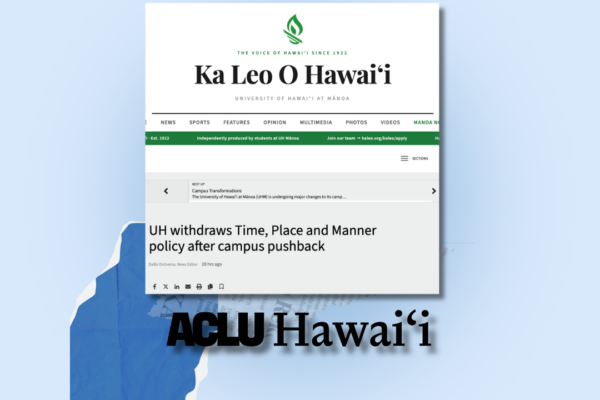
Author: Dallis Ontiveros, News Editor
Read full article: here
The University of Hawaiʻi has withdrawn its interim Time, Place and Manner policy following concerns from students, faculty, staff and civil liberties advocates that the new rules could restrict free expression across its 10-campus system.
UH President Wendy Hensel announced the withdrawal on Aug. 26, less than two months after the interim policy took effect on July 1.
The university has since returned to the 2014 version of Executive Policy 10.206, “Free Expression on University Campuses,” while officials consider what comes next.
The interim policy established guidelines governing when, where and how expressive activities such as protests and demonstrations could take place on UH campuses.
Among the provisions that drew criticism were 25-foot setbacks from buildings, a 60-decibel noise threshold and restrictions on chalking.
In her message to the UH community, Hensel said the policy was intended to provide viewpoint-neutral guidelines that protected expressive rights while keeping campuses safe and functional for teaching and learning.
However, Hensel acknowledged that some members of the university community believed parts of the policy were too restrictive and could discourage people from participating in expressive activity.
—Your concerns have been heard.
Hensel wrote in announcing the withdrawal.
For the ACLU of Hawaiʻi, the decision demonstrates the impact students, faculty and staff can have when they collectively raise concerns about university policy.
—The withdrawal of the interim TPM policy shows what's possible when students, faculty, and staff organize together.
said Salmah Y. Rizvi, executive director of the ACLU of Hawaiʻi.
This outcome belongs to the university community, who spent more than a year making their voices heard.
Concerns surrounding the policy had been building before its withdrawal.
On Aug. 24, the ACLU of Hawaiʻi sent a letter to Hensel raising First Amendment concerns about restrictions involving chalking, sit-ins, encampments, the distribution of printed materials, noise levels and the 25-foot buffer around buildings.
The organization publicly called on UH not to permanently adopt the interim policy.
UH, meanwhile, says the policy was developed following months of consultation.
According to the university, formal consultation began in November 2025 and included faculty senates, student representatives, university leadership, unions, campus security personnel and other stakeholders. UH also met with the ACLU in June before implementing the interim policy.
Rizvi said the university community's response continues a longer tradition of activism at UH.
—UH should be proud of its tradition with generations of students standing up and speaking out on the defining issues of their time.
Rizvi said.
That history has included demonstrations over issues ranging from the Vietnam War to efforts to protect Maunakea.
Bachman Hall and other prominent areas of the Mānoa campus have also served as gathering places for student demonstrations and sit-ins.
Despite the withdrawal, the debate over free expression at UH is not finished.
—But a withdrawal is a pause, not a resolution,
Rizvi said.
What matters now is what comes next.
UH plans to continue discussions with the university community before determining a new path forward. Hensel said the university will hold in-person listening sessions during the semester to hear additional concerns, ideas and suggestions.
The university says its goal is to balance the need to maintain active learning environments with its role as a place for political and social expression.
The withdrawn policy and its previous drafts, comparisons and consultation history will remain publicly available as the process continues.
For the ACLU of Hawaiʻi, any replacement will be judged by how much room it gives students and others to exercise their First Amendment rights.
—Any revised policy must honor the First Amendment by protecting (and not policing) expression
Rizvi said, pointing specifically to concerns about buffer zones and restrictions on chalking and sit-ins.
She also called for UH to fully recognize spaces such as McCarthy Mall and Bachman Hall as traditional public forums where protest belongs.
For students on-campus this fall, the immediate result is a return to the university's previous free expression guidelines.
But what eventually replaces the withdrawn policy remains undecided.
—Students should feel confident organizing on their campuses today,
Rizvi said
adding that the ACLU of Hawaiʻi
will remain a vigilant watchdog to ensure that remains true tomorrow, regardless of the federal political climate.