
Indigenous Justice
The ACLU of Hawai‘i is committed to promoting, protecting and maintaining the civil liberties and rights of Indigenous peoples, including Native Hawaiians, guaranteed by the United States and Hawaiʻi State Constitutions.
ACLU of Hawai‘i ("ACLU-HI") Land Acknowledgement
The ACLU of Hawai‘i (“ACLU-HI”) sits upon unceded lands of the Kingdom of Hawai‘i, which have been stewarded by Kānaka ‘Ōiwi for thousands of years. The ACLU-HI recognizes that Native Hawaiian rights are not relinquished and claims with the United States remain unsettled. We support the meaning of aloha ‘āina as a way of knowing, being, and living that reflects the cultural and political relationship of Kānaka ‘Ōiwi as ‘āina stewards. While we work to protect the civil liberties of all Hawaii’s residents, we honor the unique voices of Kānaka ‘Ōiwi in our pilina and kuleana to them as an organization in Hawai‘i.
ACLU National & ACLU-HI's Policy on Indigenous Justice
Native Hawaiians are a distinct, Indigenous people whose ancestors were the original inhabitants of what is currently considered the State of Hawaiʻi. Founded by King Kamehameha, the Hawaiian Kingdom held a treaty relationship with the United States which included, among other assurances, the promise of perpetual “peace and friendship.” In 1893, these treaties were violated when the United States, through its military and diplomatic corps, assisted in the illegal overthrow of the Hawaiian Kingdom. In 1993, on the 100th anniversary of the overthrow, the United States Congress passed – and President Bill Clinton signed – Public Law 103-150, which admitted wrongdoing on the part of the United States, offered an apology to the Native Hawaiian people, and committed to a policy of reconciliation between the United States federal government and Native Hawaiians.
Since declaring jurisdiction over Hawaiʻi over a century ago, Congress has passed numerous laws recognizing the rights of Native Hawaiians as Indigenous people as comparable to “American Indians and Alaska Natives.” Through statute and regulations, the United States federal government has determined that its constitutional authority to set policy concerning Indigenous people includes Native Hawaiian affairs. To date, Congress has passed over 180 Acts concerning Native Hawaiians and the United States has affirmed the “special legal and political trust relationship” between Native Hawaiians and the United States.
The ACLU supports and may defend the rights of Native Hawaiians under United States law and acknowledges that those rights are based not on race, but on the rights of Native Hawaiians as a unique, Indigenous people who have never relinquished their sovereignty or settled their claims with the United States.
Through the adoption of Policy 313, ACLU National has also committed to promoting and protecting tribal sovereignty, the civil rights and liberties of all Indigenous peoples living in what is now called the United States, and recognizing the unique status of Native Hawaiians.
ACLU National and ACLU-HI Position on Sovereignty
Peoples indigenous to what is now the "United States" have inherent sovereignty: the right to govern themselves and their lands and to determine their own futures. Despite Supreme Court jurisprudence to the contrary, this sovereignty predates the existence of the United States, the drafting of the Constitution, and the creation of individual states. It is not dependent on external recognition. The ACLU is committed to defending the right of Indigenous people to exist as Indigenous people.
The ACLU’s work protecting and advancing tribal sovereignty includes the right to: a tribal land base and appurtenant natural resources; self-government, including the right to exercise jurisdiction over their lands and people with minimal interference by local, state and federal governments; government-to-government relationships with state and federal governments; the right to define the means and mechanisms of participation and decision-making regarding any and all laws, policies and practices that impact them1; preservation and enjoyment of their cultural and religious heritage, including traditional ways of being, healing, and knowing; language and ceremony; access and stewardship of ancestral lands, especially those of particular sacred or spiritual importance; and the enforcement of the commitments made to them by the United States in treaties, compacts, and by other governmental actions.
Stewardship at Stake: Legal Considerations for Protecting Hawaiʻi Lands from Government Overreach
This paper responds to community requests for the American Civil Liberties Union of Hawai‘i to outline the statutory and constitutional limits on the United States (“U.S.”) military and State of Hawaiʻi with respect to decision making over Public Land Trust lands currently under military lease. This includes, but is not limited to, duties related to the unrelinquished claims of Native Hawaiians with respect to the Hawaiian Kingdom lands currently recognized as the Public Land Trust under state and U.S. federal law.
The Latest
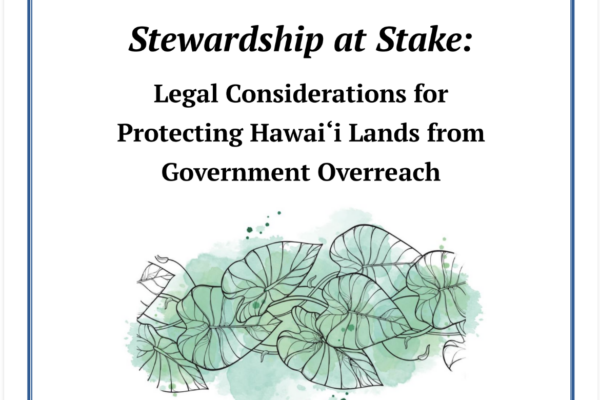
Stewardship at Stake: Legal Considerations for Protecting Hawaiʻi Lands from Government Overreach
ACLU of Hawaiʻi Stands in Solidarity with Kamehameha Schools
Stay Informed
Sign up to be the first to hear about how to take action.
By completing this form, I agree to receive occasional emails per the terms of the ACLU’s privacy statement.
By completing this form, I agree to receive occasional emails per the terms of the ACLU’s privacy statement.