
Published: June 5, 2026
Full story available here.
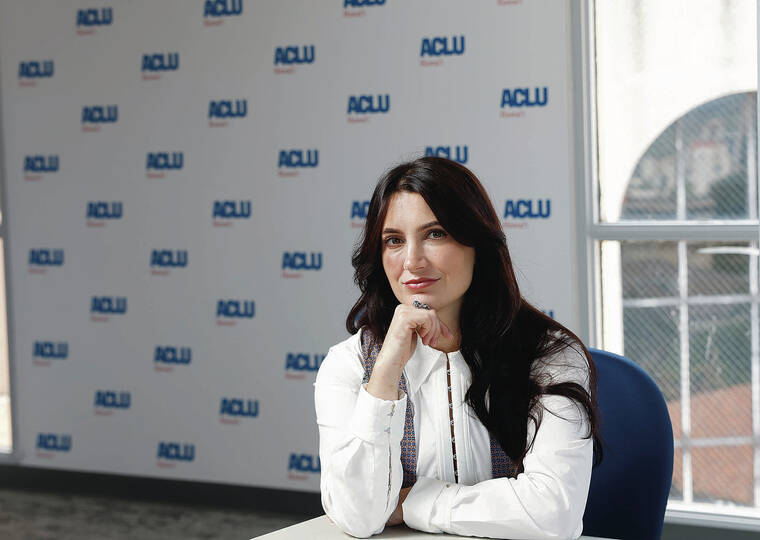
What’s your role with the ACLU of Hawai‘i?
We work to protect civil rights and liberties here in Hawaii, with litigation, policymaking, community organizing and public education. In this moment, defending civil rights is an all-hands-on-deck situation. I direct the policy department, working closely with state legislators, City Council members and government agencies to ensure public policy and procedure protect our civil rights — affecting whether people’s private data is shared with federal authorities, for example, or discrimination prevents people from accessing healthcare. Our perspective is that opponents can be allies, if given more information.
What are ACLU of Hawai‘i priorities?
Protecting communities against U.S. Immigration and Customs Enforcement overreach and lawlessness became a top concern when Donald Trump regained the presidency. Partnering with advocates at the Hawai‘i Coalition for Immigrant Rights, The Legal Clinic, Indivisible and others, we advocated for legislation; immigrant-rights staff attorney Leilani Stacy was indispensable in this effort. And Senate Bill 2057 passed: introduced by Sen. Jarrett Keohokalole and co-authored by Rep. Jeanné Kapela, it bans Hawaii law enforcement from agreements to carry out ICE’s bidding.
With Hawaii’s history as the first state to legalize abortion, and the honored role of transgender and mahu people in kanaka maoli culture, another priority is protecting access to reproductive and gender-affirming care. With other advocates, we supported an amendment to Hawaii’s reproductive health care shield law to include gender-affirming care protections; that bill is now Act 059.
Finally, we’ve been working for years on pretrial fairness. Many people sit in overcrowded jails not because they pose a threat, but because they cannot afford to pay bail. Our policy advocate Josh Frost led reform efforts, advocating that people receive needed services such as housing or mental health treatment, rather than being caged for 23 hours a day.
How is your advocacy structured?
The policy team works across departments to develop strategies on these topics that harness litigation, policymaking and community organizing. I work alongside brilliant colleagues like Sergio Alcubilla and Wookie Kim, who lead our community engagement and legal teams. Thanks to them, their teams, our Executive Director Salmah Rizvi and our Development Director Jana Light, our membership has doubled in recent years.
ACLU of Hawai‘i is part of the Reimagining Public Safety in Hawai‘i Coalition. Tell us more: how open is Hawaii to reform?
The Reimagining Public Safety coalition is a community-driven coalition facilitated by former ACLU field fellow, Emily Sarasa. The vision is one where communities — not police, prisons or the for-profit prison industry — are centered in decisions about safety. As for Hawaii’s appetite for reform: Pandemic-era misinformation sparked a nationwide backlash against bail reform, and opinions here reflect some of that. However, there’s also mounting frustration with our criminal justice system in Hawaii. There’s growing recognition that the answer isn’t more incarceration. We need to truly reimagine the entire system.
What motivates you to take part in this effort?
Like all of us at the ACLU of Hawai‘i, I’m justice-aligned. I was raised by an intelligent and opinionated mother who taught me to push back against falsities and unjust actions; my grandmother created a better life for her family after escaping an abusive home at age 17. My career feels more like a calling, as corny as that sounds: I believe our purpose is taking care of each other, and I fulfill that purpose in my work.
This is also personal. I’m a lesbian, and will not stand by while the rights of my community are under attack, or while the far-right distorts and weaponizes values such as gender equity to turn us against trans people. I’m raising a son and want him to grow up understanding that all women, trans women included, deserve respect and dignity.
I’m also a survivor of childhood sexual assault. At the time, the criminal justice system didn’t help me or my family find healing or justice. For years, I wanted the perpetrator, who was also a child, to be punished. I came to learn, however, that crimes often arise from trauma: The boy was likely assaulted himself and was provoked by that injury. This shifted my outlook and helped me find compassion.
Understanding that trauma often underlies involvement with the criminal justice system creates a focus on healing as the best way to stop the cycle. This belief that people are more than their worst moment, and worthy of redemption and healing, guides my work in reform.
Copyright 2026 Honolulu Star Advertiser. All rights reserved.