Tuesday, October 27, 2026
By Sarah Bernardo
Read Full Article: Here
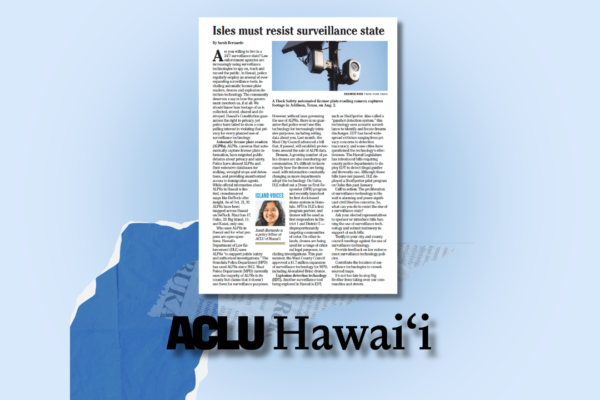
Are you willing to live in a 24/7 surveillance state? Law enforcement agencies are increasingly using surveillance technologies to spy on, track and record the public. In Hawaii, police regularly employ an arsenal of ever-expanding surveillance tools, including automatic license plate readers, drones and explosion detection technology. The community deserves a say in how the government monitors us, if at all. We should know how footage of us is collected, stored, shared and destroyed. Hawaii’s Constitution guarantees the right to privacy, yet police have failed to show a compelling interest in violating that privacy for every planned use of surveillance technology.
Automatic license plate readers (ALPRs). ALPRs, cameras that automatically capture license plate information, have reignited public debates about privacy and safety. Police have abused ALPRs and their extensive databases for stalking, wrongful stops and detentions, and providing unauthorized access to immigration agents. While official information about ALPRs in Hawaii is limited, crowdsourced maps like DeFlock offer insight. As of Oct. 21, 92 ALPRs have been mapped across Hawaii on DeFlock. Maui has 47; Oahu, 33; Big Island, 11; and Kauai, only one.
Who uses ALPRs in Hawaii and for what purpose are open questions. Hawaii’s Department of Law Enforcement (DLE) uses ALPRs “to support public safety and authorized investigations.” The Honolulu Police Department (HPD) has used ALPRs since 2012. Maui Police Department (MPD) currently uses the majority of ALPRs in its county but claims that it doesn’t use them for surveillance purposes. However, without laws governing the use of ALPRs, there is no guarantee that police won’t use this technology for increasingly intrusive purposes, including selling data about you. Last month, the Maui City Council advanced a bill that, if passed, will establish protections around the sale of ALPR data.
Drones. A growing number of police drones are also monitoring our communities. It’s difficult to know exactly how the drones are being used, with information constantly changing as more departments adopt the technology. On Oahu, DLE rolled out a Drone as First Responder (DFR) program and recently launched its first dock-based drone system in Honolulu. HPD is DLE’s first program partner, and drones will be used as first responders in District 1 and District 5 — disproportionately targeting communities of color. On other islands, drones are being used for a range of criminal legal purposes, including investigations. This past summer, the Maui County Council approved a $1.7 million expansion of surveillance technology for MPD, including AI-enabled Brinc drones.
Explosion detection technology (EDT). Another surveillance tool being explored in Hawaii is EDT, such as ShotSpotter. Also called a “gunshot detection system,” this technology uses acoustic surveillance to identify and locate firearm discharges. EDT has faced widespread criticism ranging from privacy concerns to detection inaccuracy, and some cities have questioned the technology’s effectiveness. The Hawaii Legislature has introduced bills requiring county police departments to deploy EDT to detect illegal gunfire and fireworks use. Although these bills have not passed, DLE deployed a ShotSpotter pilot program on Oahu this past January.
Call to action. The proliferation of surveillance technology in Hawaii is alarming and poses significant civil liberties concerns. So, what can you do to resist the rise of a surveillance state?
Ask your elected representatives to sponsor or introduce bills banning the use of surveillance technology and submit testimony in support of such bills.
Testify in your city and county council meetings against the use of surveillance technology.
Provide feedback on law enforcement surveillance technology policies.
Contribute the location of surveillance technologies to crowdsourced maps.
It’s not too late to stop Big Brother from taking over our communities and streets.