
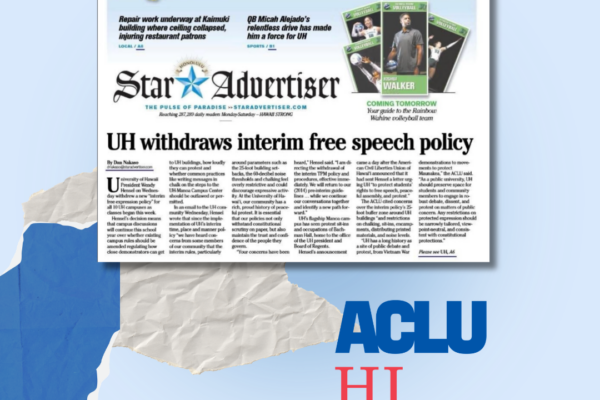
University of Hawaii withdraws free speech, assembly changes
By Dan Nakaso
Aug. 27, 2026
read full story here
University of Hawaii President Wendy Hensel on Wednesday withdrew a new “interim free expression policy” for all 10 UH campuses as classes began this week.
Hensel’s decision means that campus discussions will continue this school year over whether existing campus rules should be amended regulating how close demonstrators can get to UH buildings, how loudly they can protest and whether common practices like writing messages in chalk on the steps to the UH-Manoa Campus Center should be outlawed or permitted.
In an email to the UH community Wednesday, Hensel wrote that since the implementation of UH’s interim time, place and manner policy “we have heard concerns from some members of our community that the interim rules, particularly around parameters such as the 25-foot building setbacks, the 60-decibel noise thresholds and chalking feel overly restrictive and could discourage expressive activity. At the University of Hawai‘i, our community has a rich, proud history of peaceful protest. It is essential that our policies not only withstand constitutional scrutiny on paper, but also maintain the trust and confidence of the people they govern.
“Your concerns have been heard,” Hensel said. “I am directing the withdrawal of the interim TPM policy and procedures, effective immediately. We will return to our (2014) pre-interim guidelines … while we continue our conversations together and identify a new path forward.”
UH’s flagship Manoa campus has seen protest sit-ins and occupations of Bachman Hall, home to the office of the UH president and Board of Regents.
Hensel’s announcement came a day after the American Civil Liberties Union of Hawai‘i announced that it had sent Hensel a letter urging UH “to protect students’ rights to free speech, peaceful assembly, and protest.”
The ACLU cited concerns over the interim policy’s 25-foot buffer zone around UH buildings “and restrictions on chalking, sit-ins, encampments, distributing printed materials, and noise levels.
“UH has a long history as a site of public debate and protest, from Vietnam War demonstrations to movements to protect Maunakea,” the ACLU said. “As a public university, UH should preserve space for students and community members to engage in robust debate, dissent, and protest on matters of public concern. Any restrictions on protected expression should be narrowly tailored, viewpoint-neutral, and consistent with constitutional protections.”
UH’s interim policy, according to the ACLU, could “chill students and community members from engaging in demonstrations, distributing literature, organizing events, or otherwise participating in constitutionally protected expressive activity.”
After Hensel’s announcement Wednesday, Salmah Y. Rizvi, executive director of the ACLU of Hawai‘i, called UH “a special place with a proud tradition of students and faculty standing up and speaking out against the injustices of their time. The ACLU of Hawai‘i will remain a vigilant watchdog, using all of our integrated advocacy tools of litigation, legislation, and community engagement to ensure that First Amendment freedoms are staunchly protected across the pae ʻaina, regardless of the federal political climate.”
Wookie Kim, the ACLU’s legal director, in a statement added that, “The University made the right call to withdraw the interim policy. President Hensel deserves credit for listening to the broader university community, which spent more than a year raising these concerns before we sent our letter.
“Of course, a pause is just a pause,” he said. “What matters is what the revised policy looks like. We hope the University drops the 25-foot buffer zones, allows chalking and sit-ins, and recognizes that certain locations (like Bachman Hall and McCarthy Mall) are traditional public forums. A policy that does these things would preserve the University’s longstanding role as a site of protest and debate around the most important issues of the day in Hawai‘i.”