
Published July 29, 2026
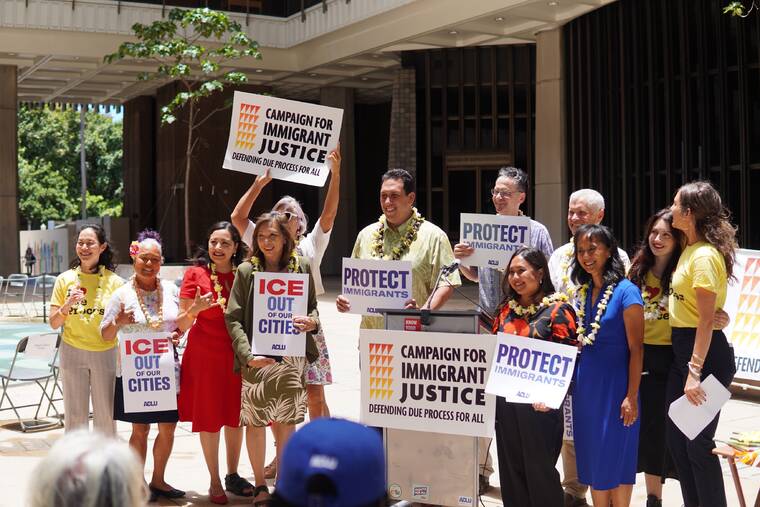
Community advocates, immigrant rights organizations, lawmakers and faith leaders gathered Tuesday at the state Capitol to celebrate the recent signing of six new state laws aimed at strengthening protections for immigrants.
The event, organized by the Campaign for Immigrant Justice and led by the American Civil Liberties Union of Hawaii, the Hawaii Coalition for Immigrant Rights and The Legal Clinic,
included a memorial for the 64 people they said have died in immigration detention or enforcement actions under President Donald Trump’s administration.
The new laws passed during the 2026 legislative session and signed Friday by Gov. Josh Green address cooperation between state and federal immigration and law enforcement authorities, legal protections for immigrants, sentencing, protections for crime survivors, immigration enforcement at sensitive locations and language access.
Mandy Fernandes, policy director for the ACLU of Hawaii, said the measures were the result of years of advocacy.
“We thank our community members, coalition partners and state legislators for their tireless efforts this session to pass a number of immigrant justice bills that serve as a model for other jurisdictions,” she said.
Introduced by state Sen. Jarrett Keohokalole (D, Kaneohe-Kailua) and co-authored by state Rep. Jeanne Kapela (D, Volcano-Hawaiian Ocean View), Act 141 prohibits state and local agencies from entering certain cooperation agreements with federal immigration authorities, including 287(g) agreements and some data-sharing arrangements. Supporters say the law is intended to limit the use of local resources for federal immigration enforcement.
Local and state police are also banned from detaining people for immigration purposes, questioning people about their immigration status or sharing personal information about community members that isn’t public.
“Our police answer to us, the communities they serve — not to ICE,” Fernandes said.
She also highlighted Act 161, introduced as part of the Filipino Caucus legislative package chaired by state Rep. Gregor Ilagan (D, Hawaiian Paradise Park-Hawaiian Beaches-Leilani Estates), which requires state and local officials to notify people in custody of their rights before any interview with U.S. Immigration and Customs Enforcement, including the right to decline the interview.
The notification must be provided in a language the individual understands, a change supporters say is intended to increase transparency and ensure people can make informed decisions before speaking with federal immigration officials.
Fernandes also pointed to Act 143, introduced by state Rep. David Tarnas (D, Hawi-Waimea-Waikoloa), which reduces the maximum sentence for certain misdemeanor offenses from one year to 364 days — one day short of the full year.
“Even low-level offenses can trigger deportation if they carry a potential one-year sentence,” she said. “This Hawaii law now reduces that sentence by a single day — to 364 days — to avoid imposing an outsized punishment simply because of where someone was born.”
The other measures signed into law include Act 142, which establishes uniform statewide standards for state and county agencies issuing U and T visa certifications for noncitizen victims of crime who assist law enforcement, and Act 162, which requires state and county agencies operating protected community locations to adopt written policies governing immigration enforcement, including procedures for verifying warrants, protecting nonpublic areas and limiting the collection of certain immigration-status information.
Act 163 would require military security forces to be notified when protective orders involve military-affiliated individuals and directs the Judiciary, the state Department of Law Enforcement and county police departments to establish related policies and procedures, while Act 179 creates a Language Access Education and Workforce Development Program at the University of Hawaii to expand the state’s language-access workforce.
Keohokalole said he introduced several of the bills after hearing about an immigration enforcement operation on Maui.
“I introduced all those bills because over the summer I heard a story of an ICE raid that took place in a neighborhood on Maui,” he said. “Federal employees kicked the door down of the home. They proceeded to pull out the occupants early in the morning, some of them still in pajamas — 13 women altogether.”
Keohokalole said he was disturbed by the operation, saying there was “absolutely no safety justification” for it regardless of the individuals’ immigration status.
“This country was founded on principles, equal rights, the honoring of civil rights and due process of all people,” he said. “We had wars that were fought to determine what a person is and who gets endowed with those rights. Lives were lost to protect that freedom. It’s part of the legacy to keep that going because what country are we if we do not afford equal rights to all of the people that reside here?”
The Campaign for Immigrant Justice said it plans to continue outreach on immigrant rights and is planning a Hawaii Immigration and Inclusion Conference for September.
Copyright 2026 Star Advertiser. All rights reserved.