
By The Civil Beat Staff
Published November 16, 2025
Full Story Also Available Here.
The American Civil Liberties Union of Hawaiʻi is a nonprofit, nonpartisan organization with a mission to protect the civil rights and liberties secured in state and federal constitutions through litigation, legislation and education. The group’s executive director, Salmah Rizvi, met with Civil Beat editors Tuesday to talk about the group’s recent work.
Rizvi, a child of immigrants, holds a juris doctor from NYU School of Law, a master’s degree from Georgetown’s School of Foreign Service and a bachelor’s in anthropology from Johns Hopkins University. She is a former associate of the global law firm Ropes & Gray and a clerk for Judge Theodore A. McKee of the U.S. Court of Appeals and Judge J. Michael Seabright of the U.S. District Court of Hawai‘i.
Rivzi began by speaking about ACLU Hawaiʻi‘s top priorities. This interview has been edited for length and clarity and with an eye toward future reporting.
We’re going to be launching new strategic planning in early 2026. Immigration is top of mind as a necessary pathway that we’re going to be pursuing. Anti-authoritarianism, which may or may not include components of demilitarization on the islands, is also going to be top of mind, as well as LGBTQ rights and gender equity — sort of in one bucket — looking at ways in which we can protect women’s reproductive rights, as well as the ever expanding threats against our trans neighbors. That’s going to be another bucket.
And of course we’re going to be preserving our Smart Justice work (addressing systemic racial inequalities while reducing incarceration) that we have been doing for a number of years — that is still on our 2020 strategic plan, and is likely to be continued to be part of our priorities.
I want folks to start thinking about the American Civil Liberties Union of Hawaiʻi in three components. We are, one, a litigation shop that most people in town have been familiar with for years. Legal director Wookie Kim is involved with that. We are also a policy shop. We have a new policy director, Mandy Fernandez, and you’re going to be seeing our legislative priorities.
And we have a community engagement wing run by Sergio Alcubilla. When I started two years ago, I realized that was a missing component, that the public was just not educated. So the role of the community engagement wing is to educate the public — and this is important — because we know that if we are able to get 3.5% of the population mobilized to engage in civil resistance, we can overcome the democratic backslide that we’re seeing happening right now.
Is this the first community engagement director for the local ACLU?
It is the first community engagement director that we have. It is sort of a combination of what some might consider in traditional ACLU structures the director of field and communications. But we’re just revamping that, and we’re making that all about community engagement. And we’re so lucky to have Sergio, who is the former executive director of Hawaiʻi Workers Center, and that is part of my vision as well — that the ACLU, while we do great work in the legal and the policy realm, we need to start overlaying our issues with economic justice.
And so we’re going to be working with the unions, we’re going to be working with other workers activists in town to figure out how we can combine and synergize in order to demand the kinds of changes that we need. Because there’s no issue we’re going to talk about today that doesn’t overlap economic justice.
Earlier this week you spoke to the Public Safety Committee in the House on an update on the Deportation Data Project (government immigration enforcement datasets), as well as some recommendations in light of what’s been going on with ICE and federal immigration orders and so forth. What did you tell the Legislature?
I think what Monday’s meeting signaled was that there is political willpower to do something about what is happening here locally. It was a great first step of opening up the conversation and hopefully laying some groundwork for some really substantive changes in the Legislature in January.
From our standpoint as the ACLU, we need to be protecting the law enforcement infrastructures that we have in the state from federal encroachment. That’s what we need to be doing. So we’re looking at what are the different policy ways, and what are the different legal ways that we can ensure that our law enforcement agents are not co-opted by the federal government. There’s a few ways of which we can do this, and you’re going to see us try to come to the table in legislative season.
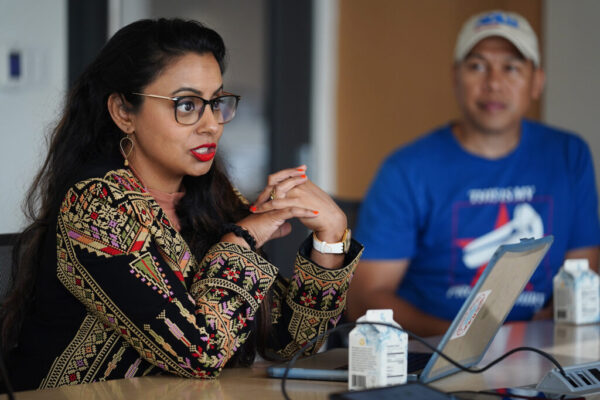
Salmah Rizvi, executive director of ACLU of Hawaiʻi, spoke with Civil Beat editors Wednesday in Honolulu. (Kevin Fujii/Civil Beat/2025)
One is we want to make sure that local law enforcement does not engage with federal ICE agents or Enforcement Removal Operations officers to ensure that there is not a local engagement in what’s called the 287(g) agreement. (It allows U.S. Immigration and Customs Enforcement to delegate to state and local law enforcement the authority to perform certain immigration officer functions.)
I sent to all council members of every (county) across the state a letter asking them to have a little bit of extra oversight over their police departments to ensure that these this kinds of cooperation, these memorandum of understanding in these 287(g) agreements, do not come to fruition. Because at the ACLU we are concerned about ensuring that federalism is protected, that states have their power, that the federal government has their power, and that our local law enforcement is not incurring the liability that comes from policing the way in which ICE is policing.
You’re essentially wanting to make sure that local enforcement here honors federalism, meaning states’ rights, and you don’t want our local law enforcement engaged in helping ICE carry out these raids.
Exactly. When you look at us, we are a civil liberties institution. Civil liberties in a society are marked by how free people usually feel, or the freedom of which a society is based on the number of civil liberties that one has. So at the American Civil Liberties Union, we fight to ensure that your civil liberties are protected. Your civil liberties are given to you through the U.S. Constitution and the Hawaiʻi State Constitution. We have the freedom to speak our minds — the First Amendment, freedom of speech. We have the freedom to privacy — the Fourth Amendment — freedom from unwanted surveillance. We have the freedom to have due process when we’re being accused of certain things, and so we want to make sure that those freedoms are sustained for the long haul.
The problem with having a free society is that it can only operate if it’s a safe society. And so when local law enforcement starts doing the work of ICE, and local law enforcement starts breaking down community trust, we no longer have a safe society in which people can be free.
Does this have to be done legislatively?
Yes, that needs to be done. So we are going to be partnering with other organizations. A partner organization will be introducing this bill, which is a 287(g) ban, which means the state can come in and say that local law enforcement agencies are not allowed to enter into cooperative agreements with ICE. If we can get that law passed, then we will be able to ensure that we have integrity and autonomy in the way in which the police conducts itself.
Is it your sense that lawmakers were receptive, at least on the committee, that you spoke to?
Yes, my sense is that law makers are receptive. I also know that lawmakers understand that a good number of Hawaiʻi residents classify themselves as immigrants. There are different studies, but around 20% of our population is or is directly impacted, or has a family member impacted by what is happening, and so we should really care about immigration as a community.
Sergio Alcubilla, director of community engagement at the ACLU Hawaiʻi, is part of an expanded outreach effort by the group. (Kevin Fujii/Civil Beat/2025)
One bill that we are introducing, that we’re the author on, is on “no secret police.” It is going to ensure that local law enforcement, or anyone, any kind of law enforcement, even federal agents that are working with this state, are not masked when they’re conducting their operations, as well as being identified. Now we understand that there may be health reasons to wear a mask that is covered for in the bill, but there still needs to be identification.
What is scaring the community the most is that essentially what looks to be like thugs are going in the streets and tearing families apart in a very aggressive manner, and that makes folks feel like they’re in the middle of gang violence. But this kind of violence is being perpetuated by the federal government and the agents that they are co-opting at this moment.
Can a state law actually make a federal agent take off their mask?
Yes, yes, it can. Not only does the state have the authority to tell federal agents that they need to be identified and not wear a secret mask for non-health reasons, but also we’ve seen in other jurisdictions around the country where you have local law enforcement agents, police departments, going and arresting ICE agents. And that is happening right now, and that’s the kind of momentum we need to build, because if ICE agents are breaking the law with due process, with excessive force, infringing upon our civil rights and civil liberties, then it is up to our police to protect us from that.
Regarding driving under the influence and this concern on the part of the ACLU that there’s been numerous civil rights violations by Honolulu police — that people who are being arrested aren’t even drinking. Can you bring us up to date on where we’ve been since that was reported?
There has been a lot going on with that case behind the scenes with the legal department, but because it is approaching active litigation right now, I don’t feel comfortable talking about the case.
Is there anything you can say generally about it?
What I know is that after we had launched notice about this case, that there have been so many folks reaching out to our office saying that they’ve been impacted. There are people coming out of the woodwork saying, “Hey, this happened to me too.” So we have, I feel like, on our hands a serious issue of a systemic problem, and I’m hoping that this case will bring bring greater transparency and accountability, and also, just even after that, potentially a conversation on rebuilding community trust.
I do want to talk about prisons and jails here. There’s really three issues. One is helping respond when inmates are killed in a facility like the Oahu Community Correctional Center. Certainly there’s the water situation in Arizona, and then, of course, there’s the concerns about building a new OCCC and whether that’s really the right approach. On that last point, your preference is to instead deal with treatment and mental health and rehabilitation.
Yes, yes, yes. If we look at the statistics, it takes $90,000 to incarcerate a member of our community. It takes $16,000 to educate one of our keiki in public schools for a year. And so you think about that, if we put upwards of more than five times the amount we would pay for somebody’s full-time education, putting that money not only toward education but actual rehabilitation, mental health services, even money for re-entry — what we know is that folks recidivate because there’s no structure for them to be able to live a healthy life. So even transitional housing, some social services to allow folks to get some some social benefits, would go a long way instead of using the $90,000 on incarceration.
The ACLU opposes building a new Oʻahu jail in Hālawa, preferring instead to focus on rehabilitation. (Cory Lum/Civil Beat/2021)
And what we know too, and what we see federally, is that the Trump administration is less engaging in a project of mass deportation versus engaging in a project of mass detention. And so one of the partner organizations we work for is called Worth Rises, and they follow the money of the prison industrial complex. And so those same forces that are operating at the federal level are also operating at the local level, and we need to build community willpower to let our legislatures know that those who are convicted of crimes need a real opportunity at a second life if we’re going to practice the values that are unique and indigenous to Hawaiʻi.
You don’t think it’s worth $1 billion of taxpayer money to build a new jail in Hālawa?
No, no, not at all. And when we think about Smart Justice, we know that over 60% of those who are incarcerated currently are there on pre-trial detention, meaning that the majority of people that are in our jails and prisons are actually not criminals. They have not yet been convicted of a crime. So one of our legislative priorities is going to be bail reform. What are the least restrictive means of confinement, and can we set bail at an amount that people can afford?
You’re up against a pretty strong coalition that opposes bail reform, certainly the prosecutor’s office here in the city and county others. This has come up again and again. What’s going to be different this time?
This time we really need the community support, as I mentioned. That is why we have our director of community engagement. It cannot just be my small staff of 15 creating these massive changes. We need the community on our side when it comes to submitting testimony in the Legislature, when it comes to writing letters to their elected officials. We are going to need to be able to build the community support in order to translate that into political willpower.
I think an interesting question to ask of legislators is, “Why not reinvest that $90,000 per person into more comprehensive rehabilitation? Why aren’t we looking to certain countries, for example, in Europe, that have completely different models of policing? Why don’t we look at other indigenous ways of policing in certain communities that engage in restorative justice?”
We need to get folks back to be civically engaged at a massive level, to engage in resistance.
There’s so many new ways to reimagine our communities, and we are at a breaking point right now where we know the old ways have not worked and have led us to this situation where we have a very small middle class and huge economic inequality, and taxpayers just paying taxes without knowing what they serve. We need to get folks back to be civically engaged at a massive level, to engage in resistance. And we’re hoping that all of the chaos that is happening at the federal level is waking people up to care about things at the local level, too.
In Arizona, where we have over 800 Hawaiʻi inmates at Saguaro, you’ve been concerned about the water there and a push for independent testing, because people have gotten sick. Where are we on that issue?
That is also something that I would want to defer to my legal director to discuss at this moment, because I don’t want to jeopardize the strategies in place.
You have a lot of irons in the fire right now, it seems to me. Is it almost too much to control? I mean, you’re attacking things on a number of different fronts.
There’s a lot. I have been told that. I am a mother of four. I’ve been on the job for two years. I came in to essentially clean up the organization and get it on firm footing so that we can be able to make the changes we want to make in this moment, responding to the historical moment. So at times, it does feel like we are embattled on many, many different fronts, but it is all worth it.
I know you’ve expanded your staff with Mandy and Sergio and so forth, but dollars are needed as well if you want to mobilize the masses to advocate for bail reform or restorative justice or to bring down the violence in the prisons and jails. Do you have those resources sufficient to pull that off?
We need more resources. What I can say is that I appreciate that we are lightly staffed, and I do feel like a dedicated small group of civil servants can push the state and the nation much further if we are all aligned with values and mission than, you know, teams of armies. And so I do feel that we can do a lot, but if we were to be able to, say, double our revenue or get more folks to become member donors, we could do so much more.
I mean, we are the American Civil Liberties Union of Hawaiʻi. We are seen to capture every kind of civil liberties or every civil rights issue in town. But we just don’t, like you said, have the resources or have the bandwidth. So we try to focus on what is really strategic at a high impact level. And what we’re doing to sort of get the community mobilized is being very creative in how we use social media tools and how we use other methods of engagement.
This Sunday at Capitol Modern we are doing a People’s Fair. Our point is to attract people to something fun, so that we’re not always talking about the grim and the injustice that our folks face, but we’re saying, “Hey, come to this event. The People’s Fair on Sunday.” There’s going to be music, there’s going to be food, there’s going to be free events for keiki, they’re going to be yoga classes. There’s going to be four panels back to back, about immigrant rights, about imagining the next 250 years of democracy, about economic justice, an executive director roundtable with other executive directors of ACLU affiliates that are traveling to town for this.
We’re hoping that will be one step to getting people interested in our work and seeing what we’re about, demystifying the ACLU so that hopefully they can stay with us as volunteers when it comes to pushing for the kind of mobilization we need.
Here’s another issue that we’ve reported on, led by you folks in part, of the FDA imposing restrictions on accessing mifepristone. Can you tell us where we are there, or is it involved in litigation?
No, because Judge Jill Otake’s ruling just came down in that case that we won on our motion for summary judgment.
What did you win?
We won on our claims that that mifepristone is a safe and effective medication used in more than 60% of abortions nationwide, and that the restrictions that were placed on the use of this drug do raise a legal question and to the level that could warrant trial if there’s any wrongdoing. So that’s where we’re at. We’ve won the motion for summary judgment, meaning that we have viable claims, and now the question is whether or not the government responds in a way that might reach to settlement or if we move on to trial.
The long term goal is to stop the FDA from from limiting access to this drug, particularly in Hawaiʻi, but nationwide as well.
Yes.
I’m guessing this has only become more pronounced since the Dobbs ruling (overturning Roe v. Wade) with the U.S. Supreme Court.
Yes.
Regarding the homeless, you guys have been at the forefront for a long time. But then there was the court ruling regarding Grants Pass last year, there’s still very much concern on your part about sweeping homeless people and the difficulties of them getting their belongings back. The court essentially has given the mayor the authority to go and continue doing these these sweeps.
We know that Grants Pass was a dreadful decision for our houseless neighbors, and that Grants Pass is just another way in which the Supreme Court has signaled to states that they can criminalize poverty. Those who have nowhere else to go or have nowhere to sleep are still being targeted in these sweeps.
What we do know, though, is that our (Hawaiʻi) Supreme Court last year guaranteed that homeless neighbors, houseless neighbors, are entitled to a contested case hearing about their belongings before they are destroyed. It still is not protecting the sweeps that are happening, and we are looking at creative ways of which we can challenge these sweeps a little bit differently from the legal arguments we’ve used in the past. Now that this is the federal government and the Supreme Court has has opined in one way, we’re looking creatively at what we can do more at the state level to result in greater protections for our houseless neighbors.
But ultimately, what we’ve been seeing is that folks are being hidden in order to satiate homeowners that are concerned about the value of their properties, particularly downtown, as well as tourists. And so this is our biggest concern, that policy decisions are being made not from a place of care and consideration to those who are suffering most in our community that can’t afford a place to live, but actually in order to satisfy the most wealthy in our community, and the most wealthy that can afford to travel and visit here.
ACLU Hawaiʻi has taken an active role in the No Kings protest, which we’re calling No Dictators in Hawaiʻi. We’ve had two now. You held recently a press conference with a number of your local partners. That’s a very visible position, getting involved with something that is so obviously anti-Trump, anti-MAGA and so forth. Have you guys faced any blowback from that, any criticism for being so, if you will, overtly political here?
Well, I spoke at the rally, and in my remarks, I was very clear that the ACLU of Hawaiʻi is nonpartisan, and we understand that the harms we are seeing now did not start under Trump 1.0 and have only been emboldened by Trump 2.0 due to the Democratic institution or Biden administration that ran its course before Trump 2.0. We understand that what we’re fighting against is not President Trump. What we are fighting against are these systemic inequalities that we are seeing now play out with masks off. It’s not as if the Biden administration, or even the Obama administration — particularly the Obama administration — (wasn’t) engaging in a project of mass deportation as well, if we look at the hard numbers.
And so we continue to be staunchly nonpartisan despite the environment we’re living in, because the kind of changes we need, we want to be able to sustain them. We don’t want to just say four years from now, “Oh, great, we have a Democratic president again, everything is okay.” No, actually, what is interesting is that the Republicans are able to do this work without their masks on, and in many ways the Democratic Party has and the Biden administration particularly were engaging in certain types of work that may have, to the public, not been seen as prominently because of their speaking points or the ways in which they’re spinning issues.
There is a scholar named Hardy Merriman who has studied democratic backslide. He has looked at countries in a post-modern era, post World War II, that were democracies but then slid into what’s called democratic backslide and eventually became authoritarian regimes. And so while only 2% to 3% of democracies backslide, once they backslide, about 70% of them fall to authoritarianism. We are in a moment of democratic backslide, which means that we need to be looking toward the studies that have shown what are ways in which to save our democracy, one of which is civil resistance.
The problem with having a free society is that it can only operate if it’s a safe society.
And again, if we can get out 3.5% of the population engaged in civil resistance, that might look like rallies, that might look like talking at the Legislature, that might look like being part of a rapid response team that films when ICE raids are happening. If we can get our folks mobilized really thoughtfully, and that might even look like engaging in strikes. If we can get mobilized, we can slow down the impact that President Trump is having right now and the Republican Party in the fast way in which they’re moving. We can slow that down, and we can hope to elect new leadership in a few years from now, to kind of hold steady. So the ACLU is really engaging in tactics of deflection and delay right now.
Is it working? Is it having an impact? Certainly, there were the elections we saw in New York and New Jersey and Virginia, and maybe we will see something during the midterms. We just have gone through the longest government shutdown. And of course, these subsidies for Obamacare are going to double. Are you being effective with these rallies in changing the discourse and changing the direction of the country?
I feel like we are activating folks. My understanding is that there hasn’t been much of a protest culture in our islands for many, many years, and that that culture is coming back. And I think that culture, when we talk about effectiveness, I want to be clear that effectiveness isn’t just the result, resulting in political changes and legal changes. That is definitely part of the operation and our strategic plan, but we also want to make sure that people continue to feel free, and the best way to feel free is to exercise your rights of freedom.
The No Kings protests in Hawaiʻi were rebranded No Dictators to better represent local identity. (Leilani Combs/Civil Beat/2025)
So really, we’re not only out here trying to tell people to make sure that they are protected when they choose to speak out. We are encouraging folks to speak out. We are encouraging folks to exercise the rights that they have in order so that we can save a semblance of democracy to see that there is resistance, that there is objection. Resistance and dissent are patriotic. Folks need to know that that’s okay and that it’s good right now having a space to process what is happening.
That’s another point of the rallies — to build community when we are all seeing on our cellphones the live stream genocide in Gaza, when we are seeing on our cellphones what is happening with these ICE raids in our own backyard. We are seeing, internationally and domestically, the abuse of people in inhumane ways, and our nervous systems were not ever meant to process that level of violence. When we come to a rally together, we are showing up in community to also heal one another.